Tiny French Girls, Cruise Food, and the Safety of Leftovers
Before I get into this post, I want to say something about comments. I am reading them. I promise. I’m grateful for the kindness, support, and thoughtful responses more than I probably know how to say without sounding like I’m giving an acceptance speech in the corner of a church gym.
I may not always respond quickly, not because I don’t care, but because I’m easing into this part of blogging. Social interaction, even online, can take me a minute. This blog is meant to be a place for discussion and connection. I want that. I’m just built a little differently and sometimes have to approach the comments section like it’s a swimming pool in in March: slowly, carefully, and with one foot in first.
Please be patient with me while I find my rhythm. I’m truly grateful you’re here, and your responses mean more than you know.
I recently got back from a cruise going up the East Coast, which means I spent several days being confronted by food in every possible form.
Food on plates. Food under heat lamps. Food being paraded around with tiny tongs. Food with names that sounded like someone lost a bet in culinary school. Food that appeared at times of day when my body was still trying to remember whether we were in Boston, Portland, Quebec, or emotionally somewhere near the soft-serve machine.
Cruises are strange because they turn eating into a scheduled event, a recreational activity, a social test, and occasionally a small traffic jam.
You do not simply “get lunch.” You enter a dining ecosystem. You locate a plate. You circle. You pretend you understand where the line begins. You make eye contact with a dessert that seems too ambitious for 11:40 in the morning.
And then, at dinner, my aunt said something tasted “like a tiny little girl from France.”

There are sentences that pass through a room unnoticed, and then there are sentences that arrive wearing a beret, carrying a tiny suitcase, and refusing to identify themselves.
This was the second kind.
I knew what she probably meant.
Delicate. Dainty. French. Maybe the sort of thing you would eat near a window while someone named Colette adjusted a scarf and judged your jam selection. Maybe something that should be eaten while a bicycle leans outside and someone named Amélie is emotionally attached to a spoon.
But that is not what came out.
What came out was:
“Tastes like a tiny little girl from France.”
Which is less “culinary review” and more “fairy-tale villain describing soup.”
It is not a normal flavor profile. It is the sort of thing a witch says in a children’s book right before the shutters slam closed.
The funny thing is, underneath my horror at the wording, I do understand admiring the French way of eating. Not every part of it. Some cultural habits can stay exactly where they are, wearing linen and minding their own business. Some of it can keep walking.
But the slower pace? The sitting down? The small portions? The real butter? The fruit that looks like someone cared about it? The idea that food should be tasted, not inhaled over a sink while answering a text?
That part I respect.
There is something beautiful about making a meal feel like a moment.
There is something elegant about people who can eat slowly because they are enjoying the meal.
I eat slowly because somewhere around age nine, my brain became a courtroom.
I don’t remember the exact moment it happened. Childhood is rude that way. It gives you a feeling, hides the receipt, and then twenty-five years later you are sitting in a restaurant wondering why you are still nibbling one corner of a sandwich like a nervous park squirrel.
I was overweight as a kid, or at least aware enough to believe everyone else was aware.
That is its own education.
Some children learn multiplication tables. Some learn cursive. Some learn state capitals. Some learn how to take bites only when no one is looking.
I think I learned early that eating in front of people felt like evidence.
Not food.
Evidence.
If I took too big of a bite, it meant something. If I finished my plate, it meant something. If I enjoyed the fries too openly, it meant something.
A normal child might see chips and salsa and think, “Excellent, civilization has peaked.”
I saw them and imagined the room quietly preparing a closing argument.
The prosecution calls the queso to the stand.
So I became careful.
Small bites. Slow bites. Strategic bites. Bites taken during moments of distraction, like when someone told a story or the waiter appeared or a cousin started explaining a work situation no one fully understood but everyone politely nodded through.
I let conversations cover me like a magician’s curtain.
I learned the restaurant version of survival: fork down, napkin adjusted, water sipped, eyes attentive, laugh at the right times, look like a person who came for the company and accidentally found a plate in front of her.
I learned how to look present without looking hungry.
Which is a very sad little skill, but one I apparently mastered like a Girl Scout badge no one should have to earn.
And honestly, I did come for the company.
That’s the strange part.
I like going out to eat.
I like restaurants. I like the clink of silverware and the weird confidence of laminated menus. I like the hum of a restaurant, the clatter of dishes, the way conversations overlap until the whole room sounds like a sitcom without a laugh track.
I like hearing what everyone orders.
I like the drama of someone saying, “I’ll just have a salad,” and then stealing half the fries from the center of the table, as nature intended.
I like being included.
I like the conversation.
I like sitting at the table.
I like being out in the world.
I just do not always feel free to eat in it.
So I become the last one to finish.
Always.
Everyone else is done. Napkins are crumpled. Plates are pushed away. Chairs shift back. Someone has entered the part of dinner where they discuss traffic or weather or who has to get up early.
Meanwhile, I am still cutting one piece of chicken into smaller and smaller units until it could be used in a dollhouse.
Then the waiter comes by and says, “Still working on that?”
Working on it.
What a phrase.
As though my dinner and I are in couples counseling.
As though I am drafting a zoning proposal instead of facing a chicken sandwich. As though the fries and I have entered mediation. As though my plate is a group project and I am the only one who read the instructions.
Then comes the box.
The box is freedom disguised as cardboard.
Some people see leftovers as tomorrow’s lunch.
I see them as emotional relocation.
I see them as a private treaty between me and my nervous system.
At home, everything changes.
The food becomes food again.
Not evidence. Not performance. Not proof. Not a tiny courtroom with ranch dressing. Not a public service announcement about my body.
Just food.
I can eat it in front of the TV, where fictional people have the decency to be too busy with their own plot lines to monitor my fork.
No one in a cozy mystery pauses the investigation to say, “Wow, you really like potatoes.”
No one in a sitcom leans out of the screen and asks why I did not finish at the restaurant.
No one in a dramatic period piece looks at my plate unless the plate contains a clue, a poison, or a scandalous letter.
That is the beauty of fictional people.
They may make terrible romantic decisions, hide bodies, inherit houses, run bakeries, solve murders in impractical shoes, or be widowed pie-makers with emotional damage, but they do not judge me for enjoying my leftovers.
They are busy having plot.
I love them for that.
There is comfort in eating with characters who have their own problems. They are trapped in their own episode, and I am allowed to be in mine.
For years, I thought my slow eating was just a quirk. One of those harmless personal details, like needing to know the parking situation before going somewhere or remembering a childhood nacho with the emotional intensity other people reserve for weddings.
But now I wonder if it was not random at all.
Maybe it was learned.
Maybe I became the last one to finish because part of me was trying not to be seen finishing.
Maybe I brought food home because home was where the meal stopped being a statement about my body.
Maybe I learned to enjoy the outing and save the eating for later.
Maybe at some point I decided the safest way to eat in public was to become nearly invisible. To participate without appetite. To enjoy the conversation and save the meal for later, when no one could grade me.
That makes me sad, but not in a dramatic throw-myself-onto-a-chaise-lounge way.
More in the way you feel sad when you find an old picture of yourself and realize that younger version of you was carrying something she did not have words for yet.
Or like finding an old photo of yourself wearing something terrible, and instead of judging her, you think, “Oh honey. You were doing your best with the closet you had.”
Because that little girl was not ridiculous.
She was trying to protect herself.
She was trying to be at the table without becoming the topic.
She was trying to avoid becoming the punchline before anyone had even made a joke.
She was trying to take up less space at a table where she already felt too visible.
And now adult me is still sometimes sitting there with her, moving peas around like they are tiny green chess pieces.
The difference is, adult me can see it now.
That feels important.
I wish she had known that eating was not a confession. That finishing a plate was not a moral failure. That enjoying food did not make her gross or unattractive or too much. That people who loved her were not sitting around waiting to become the French Revolution of mozzarella sticks.
But she did not know that.
So she adapted.
And now adult me is left trying to untangle it, one restaurant meal at a time.
Maybe that is the part of the French approach I respect most. Not the fantasy version, with scarves and tiny pastries and women who appear to understand linen pants. Not the exact rules. Not the cultural costume people like to put on it. Not the striped shirts and tiny desserts named after women who look like they own good scarves.
Just the permission.
To sit.
To taste.
To enjoy.
To not apologize for pleasure.
To let food be food.
Not a trial. Not evidence. Not a character flaw with a garnish. Not a performance review served with a side salad.
Just food.
Something warm. Something strange. Something delicious. Something worth tasting while it is still at the table.
I may always be the last one to finish. There are worse roles. Someone has to keep the waiter employed in the phrase “still working on that?”
But maybe I can practice being a little less invisible.
Maybe I can take a real bite in public.
Maybe I can let myself enjoy what I ordered while it is still hot, instead of saving all my comfort for the couch and a television cast that cannot see me.
And maybe, someday, when someone at dinner says a dessert tastes like a tiny little girl from France, I will still look baffled.
Not because I haven’t grown.
I have.
But because growth is important, and so is accuracy.
I also believe desserts should not be assigned nationalities and approximate ages.
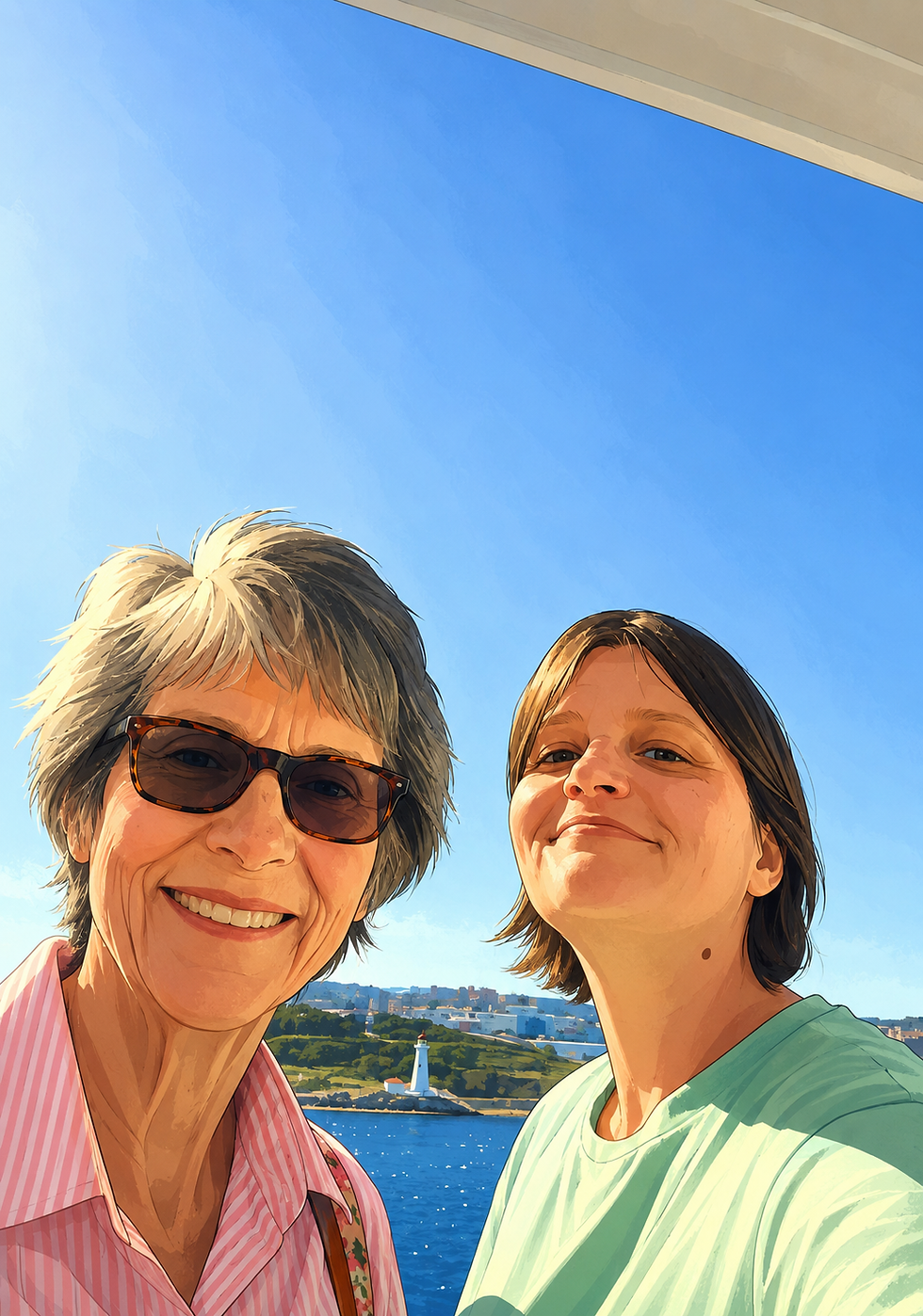
And also for the record, this is not a tiny little French girl either.


Comments